
COURSE DESCRIPTION
This independent study is designed to engage Black Feminist Research Methods. Specifically, through readings, and discussion Shannan Moore and her advisor will construct a curriculum that will introduce the ways that ethnic studies researchers engage research questions and design studies that produce results that enhance our knowledge about Black women in the diaspora.
To that end, Shannan’s project focuses on the African diaspora and the transnational intra-community conflicts around authenticity, cultural contributions, and the meaning of community. Shannan’s project is also examining the medium of these ‘diaspora wars,’ so we will also examine texts that critically engage social media and race.
required books
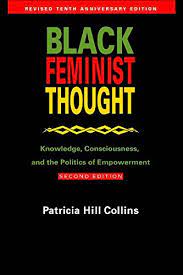
Black Feminist Thought: Knowledge, Consciousness, and the Politics of Empowerment by Patricia Hill Collins
In spite of the double burden of racial and gender discrimination, African-American women have developed a rich intellectual tradition that is not widely known. In Black Feminist Thought, originally published in 1990, Patricia Hill Collins set out to explore the words and ideas of Black feminist intellectuals and writers, both within the academy and without. Here Collins provides an interpretive framework for the work of such prominent Black feminist thinkers as Angela Davis, bell hooks, Alice Walker, and Audre Lorde. Drawing from fiction, poetry, music and oral history, the result is a superbly crafted and revolutionary book that provided the first synthetic overview of Black feminist thought and its canon.
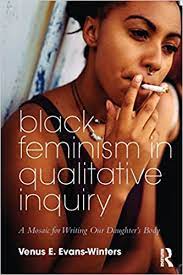
Black Feminism in Qualitative Inquiry: A Mosaic for Writing Our Daughter’s Bodies by Venus Evans-Winter
Recently, Black women have taken the world stage in national politics, popular culture, professional sports, and bringing attention to racial injustice in policing and the judicial system. However, rarely are Black women acknowledged and highlighted for their efforts to understand the social problems confronting our generation and those generations that came before us. In the post-civil rights era, research faculty and theoreticians must acknowledge the marginalization of Black women scholars’ voices in contemporary qualitative scholarship and debates.
Black Feminism in Qualitative Inquiry: A Mosaic for Writing our Daughter’s Body engages qualitative inquiry to center the issues and concerns of Black women as researcher(s) and the researched while simultaneously questioning the ostensible innocence of qualitative inquiry, including methods of data collection, processes of data analysis, and representations of human experiences and identities. The text centers “daughtering” as the onto-epistemological tool for approaches to Black feminist and critical race data analysis in qualitative inquiry.
Advanced and novice researchers interested in decolonizing methodologies and liberatory tools of analysis will find the text useful for cultural, education, political, and racial critiques that center the intersectional identities and interpretations of Black women and girls and other people of color. Daughtering as a tool of analysis in Black feminist qualitative inquiry is our own cultural and spiritual way of being, doing, and performing decolonizing work.
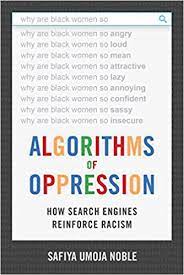
Algorithms of Oppression: How Search Engines Reinforce Racism by Safiya Noble
In spite of the double burden of racial and gender discrimination, African-American women have developed a rich intellectual tradition that is not widely known. In Black Feminist Thought, originally published in 1990, Patricia Hill Collins set out to explore the words and ideas of Black feminist intellectuals and writers, both within the academy and without. Here Collins provides an interpretive framework for the work of such prominent Black feminist thinkers as Angela Davis, bell hooks, Alice Walker, and Audre Lorde. Drawing from fiction, poetry, music and oral history, the result is a superbly crafted and revolutionary book that provided the first synthetic overview of Black feminist thought and its canon.
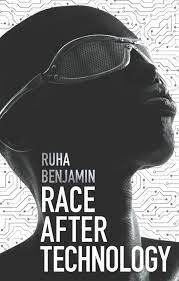
Race after Technology: The New Jim Code by Ruha Benjamin
From everyday apps to complex algorithms. Ruha Benjamin cuts through tech-industry hype to understand how emerging technologies can reinforce White supremacy and deepen social inequity.
Benjamin argues that automation, far from being a sinister story of racist programmers scheming on the dark web, has the potential to hide, speed up, and deepen discrimination while appearing neutral and even benevolent when compared to the racism of a previous era. Presenting the concept of the “New Jim Code,” she shows how a range of discriminatory designs encode inequity by explicitly amplifying racial hierarchies; by ignoring but thereby replicating social divisions; or by aiming to fix racial bias but ultimately doing quite the opposite. Moreover, she makes a compelling case for race itself as a kind of technology, designed to stratify and sanctify social injustice in the architecture of everyday life.
This illuminating guide provides conceptual tools for decoding tech promises with sociologically informed skepticism. In doing so, it challenges us to question not only the technologies we are sold but also the ones we ourselves manufacture.
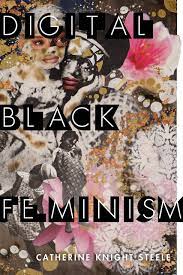
Digital Black Feminism by Catherine Knight Steel
Black women are at the forefront of some of this century’s most important discussions about technology: trolling, online harassment, algorithmic bias, and influencer culture. But, Catherine Knight Steele argues that Black women’s relationship to technology began long before the advent of Twitter or Instagram. To truly “listen to Black women,” Steele points to the history of Black feminist technoculture in the United States and its ability to decenter white supremacy and patriarchy in a conversation about the future of technology. Using the virtual beauty shop as a metaphor, Digital Black Feminism walks readers through the technical skill, communicative expertise, and entrepreneurial acumen of Black women’s labor—born of survival strategies and economic necessity—both on and offline.
Positioning Black women at the center of our discourse about the past, present, and future of technology, Steele offers a through-line from the writing of early twentieth-century Black women to the bloggers and social media mavens of the twenty-first century. She makes connections among the letters, news articles, and essays of Black feminist writers of the past and a digital archive of blog posts, tweets, and Instagram stories of some of the most well-known Black feminist writers of our time. Linking narratives and existing literature about Black women’s technology use in the nineteenth, twentieth, and twenty-first century, Digital Black Feminism traverses the bounds between historical and archival analysis and empirical internet studies, forcing a reconciliation between fields and methods that are not always in conversation. As the work of Black feminist writers now reaches its widest audience online, Steele offers both hopefulness and caution on the implications of Black feminism becoming a digital product.
articles
- Mundt, Marcia, Karen Ross, and Charla. “Scaling Social Movements Through Social Media: The Case of Black Lives Matter,” 2018.
- Tanksley, Tiera Chante’. “Race, Education and #BlackLivesMatter: How Social Media Activism Shapes the Educational Experiences of Black College-Age Women,” 2019.
- Florini, Sarah. “Tweets, Tweeps, and Signifyin’: Communication and Cultural Performance on ‘Black Twitter,’” 2014.
- Brock, André. “From the Blackhand Side: Twitter as a Cultural Conversation,” 2012.
recommended books
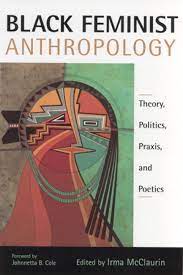
Black Feminist Anthropology: Theory, Practice, Poetics by Irma McClaurin
In the discipline’s early days, anthropologists by definition were assumed to be white and male. Women and black scholars were relegated to the field’s periphery. From this marginal place, white feminist anthropologists have successfully carved out an acknowledged intellectual space, identified as feminist anthropology. Unfortunately, the works of black and non-western feminist anthropologists are rarely cited, and they have yet to be respected as significant shapers of the direction and transformation of feminist anthropology.
In this volume, Irma McClaurin has collected-for the first time-essays that explore the role and contributions of black feminist anthropologists. She has asked her contributors to disclose how their experiences as black women have influenced their anthropological practice in Africa, the Caribbean, and the United States, and how anthropology has influenced their development as black feminists. Every chapter is a unique journey that enables the reader to see how scholars are made. The writers present material from their own fieldwork to demonstrate how these experiences were shaped by their identities. Finally, each essay suggests how the author’s field experiences have influenced the theoretical and methodological choices she has made throughout her career.
Not since Diane Wolf’s Feminist Dilemmas in the Field or Hortense Powdermaker’s Stranger and Friend have we had such a breadth of women anthropologists discussing the critical (and personal) issues that emerge when doing ethnographic research.
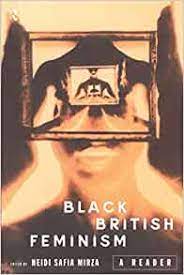
Black British Feminism: A Reader by Heidi Mirza
Black British Feminism: A Reader is a unique collection of classic texts and new black feminist scholarship. Exploring postmodern themes of gendered and racialized exclusion, ‘black’ identity and social and cultural difference this volume provides an overview of black feminism in Britain as it has developed during the last two decades.
Among the topics covered are
- white feminism
- political activism
- ‘mixed-race’ identity
- class differences
- cultural hybridity
- autobiography
- black beauty
- religious fundamentalism
- national belonging
- lesbian identity
- postcolonial space
- popular culture
This timely and important book is essential reading for students and scholars of cultural studies, women’s studies, sociology, literature, and postcolonial studies.

Thoughts on Women, Race, & Class by Angela Y. Davis and COWBOY CARTER by Beyoncé
After two weeks, I finally finished Women, Race, & Class last night! It was a slow read for me as I was finishing my Gendered Communication class and wanted to enjoy Spring Break. Given what I study, it can be hard for me to read book on history or theory that doesn’t relate to my research, but…

(an incomplete) reading list 4 liberation
Once you learn to read, you will be forever free. Frederick Douglass EDITOR’S NOTE i should start by saying this reading list is according to shay (me) and full of books i’ve read that add to my critical understanding of the world. i am only one human who’s perspective is limited which is why this…
remembrance (2024)
a poem by shay nicole the land will not forget how you came to beshe won’t forget the blood spilled or the tears shedor how homes & schools, hospitals & stores turned to rubblethe remnants of artillery shells, white phosphorus, bombsthe weight of countless martyrs — known and unknownnor will she forget those who fled…
 shay the student
Leave a comment